
Why Do Cricket Broadcasts Insist on Missing Half of the Game?
Cricket matches are won by scoring the most runs. So why do we never actually see batters running between the wickets?

Do you ever feel like something fundamental is…missing from cricket coverage?
Over my years watching cricket, I’ve developed a variety of abilities—almost none of which have any practical, real-world applications, but abilities nonetheless. Many of you probably have these same cricketing sixth senses, honed over years of sporting osmosis. I’ve got an intuition for predicting when a bowling change is imminent. I’m excellent at knowing when an LBW appeal is missing leg stump (height is more often my blind spot).
But perhaps above all, it has become second nature to judge how many runs a batter is going to take after hitting the ball in a gap. Every now and then I’ll overestimate a 3 when there were only 2 on offer, and sometimes I’ll be a bit too trigger-happy in predicting a quick single when no runs are available, but I’d estimate I can do this with ~95% accuracy. There are patterns to these things. Ball’s hit straight to an outfielder? Probably one. Ball’s hit to either side of an outfielder? You can usually sneak a second. Ball gets dabbed to the 30-yard circle with no one in the ring? You should get two (Mark Waugh used to hammer this point home on BBL commentary). Dabbed it in front of a fielder who’s sitting on their heels? You should be able to sneak a quick single. Fielder misfields one that’s hit straight to him? You know the old adage: never run on a misfield.
Usually, this is a subconscious habit. Except, recently, while watching the New Zealand vs West Indies ODI series, it clicked that I was doing this pretty much every ball, leading me to interrogate the habit further. Soon, I started asking myself, why do I have to guess how many runs they’re scoring at all, instead of actually seeing the batters running between the wickets with my own two eyes?
Cricket broadcasting has progressed an exceptionally long way from the days when we had black-and-white pictures, a static camera at one end, and technologies like Hotspot and UltraEdge were mere pipe dreams. Ironically, much of this progress has produced the opposite effect: we’ve become increasingly sophisticated at adding peripheral information around the game, whether that’s Hawk-Eye, bowling speeds, win predictors, or projected scores, while somehow becoming less effective at showing the actual game itself. Sometimes, you can get so fixated on the traditions of a sport and how it’s ‘supposed’ to be covered, that you lose sight of the forest for the trees and neglect the basics. A classic case of institutional inertia, in other words.
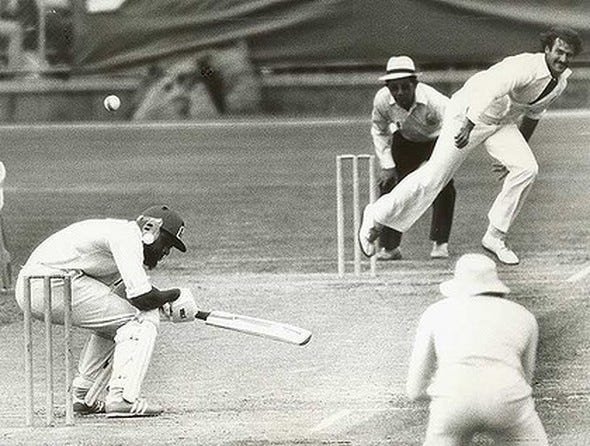
I hope I’m not telling tales out of school here, but the only way to win a game of cricket is by scoring more runs than your opponent. Yes, taking wickets helps significantly, but it is not an outright requirement—theoretically, it is possible to win a match while taking no wickets, and it is certainly possible to win while taking fewer wickets than your opponent. No, the only way to absolutely guarantee that you will win a game of cricket is by scoring the most runs. SO, WHY, ON EARTH, DO WE ALMOST NEVER SEE THE LITERAL ACT OF SCORING RUNS—RUNNING BETWEEN THE WICKETS—ON CRICKET BROADCASTS?
We see the batter hitting the ball and the fielder fielding it, but rarely see the actual, physical act of runs being scored. In effect, we’re missing a quarter of the game: we see the bowler run up and deliver the ball, the batter hitting the ball, and the fielder fielding the ball, but rarely see the batters running between the wickets. Runs just magically appear on the scoreboard, and we’re left to take everyone’s word that they were, indeed, scored.
Does this not seem like a critical oversight to anyone else? Don’t get me wrong, every now and then you’ll catch glimpses of the batters running between the wickets, depending on the camera angles and where the ball gets hit, and you’ll certainly see replays of run-outs or potential close calls. However, we very rarely see the general, ho-hum runs—an easy single or a run-of-the-mill two.
Instead, directors and camerapeople have become notorious ball-watchers. They will follow the ball off the bat to the fielder, but miss the literal act of scoring runs. Often, the commentators will keep us informed about how many runs the batters take, but not always, and standards have slipped in this regard over the decades.
What Are We Missing?
From where I’m sitting, this would be an incredibly cheap and easy thing to rectify (we’ll get to that in a second) that could offer significant, unexplored or under-discussed tactical insights into the game. For example, right now, it’s almost impossible to answer the following questions with any certainty:
Do certain batters run more slowly between wickets the longer they’re at the crease?
Are particular batters consistently guilty of ‘turning blind’ (i.e. turning for another run without looking at the fielder)?
Do certain batters consistently run with the bat in the wrong hand?
Are some batters consistently lazy about sliding their bats?
Are certain batters more likely to take on a fielder’s arm?
Which batters are the best at determining whether they’ve hit the ball to a poor fielder and can sneak an extra run, or a good fielder and they’d better play it safe?
Are particular batters more aggressive/conservative about running twos?
Are particular batters fast when running a single, but lose pace when running a two/three?
Do certain batters have ‘blindspots’ or areas where the ball gets hit that they struggle to judge?
Are some batters switched on for their own runs but lazy at the non-striker’s end?
Are some batters fast runners but slow turners?
Which batters are the best at safely judging quick singles?
Which batters lose the most potential runs because of conservative running?
Which batters convert the most singles into twos?
Which pairs consistently complete risky singles successfully?
Which batters consistently run wider arcs and lose distance?
Perhaps most importantly, are there players who score more runs simply by being elite at running between the wickets? Perhaps a batter’s ‘expected runs’ are 35, and they consistently add +5 to that by being an excellent runner between wickets.
The key point is that not showing the batters running between the wickets strips the game of crucial context: was that second run comfortable, or dicey? Is the batter starting to get tired? I’ll never really know, because we only saw the last three steps of their second run.
Running between the wickets is a fundamental part of cricket, so why aren’t we showing it? I can’t imagine another sport tolerating this. Can you imagine if the NBA switched camera angles to a defender trying to catch up to the play, rather than the ball-handler about to dunk? Or if they lingered on the player who threw the assist, rather than switching camera angles to capture the shooter? Can you imagine if rugby switched camera angles to the fullback trying to run to the corner flag to save a try, rather than the winger who’s about to score? Imagine if tennis coverage only focused on one of the players, or if football didn’t actually show the corner being kicked, instead focusing on the action in the box? So, why do we accept this in cricket? Even video game cricket figured this out in the mid-90s, yet, somehow, real-world directors are still stuck ball-watching. If nothing else, surely it would be nice for the commentators to have something else to talk about other than the same three stories about their glory days playing in the ‘90s.
When I first started playing cricket, running between the wickets was one of the things that was practised the most. You learn the fundamentals early: calling (your call in front of square, your partner’s call behind square), how to slide your bat, how to back up, how not to turn blind, how to judge a run, when to take on a fielder’s arm, and more. I remember after one game when about half of our U9s team were run-out in farcical fashion, we spent basically an entire hour-long practice session exclusively dedicated to running between the wickets (not that it helped much).
So, for such a crucial and fundamental part of the game, there is so much about running between the wickets that we don’t know. Sure, we tend to have a rough idea that guys like Glenn Phillips, Virat Kohli, MS Dhoni, and Dean Jones are lightning fast between the wickets, while the likes of Inzamam-ul-Haq and Chris Gayle have, let’s say, the opposite reputation, but beyond that, it gets pretty murky. For instance, what actually is ‘fast’ when running between the wickets? Has anyone ever thought to measure the average time it takes a batter to run a single to compare whether batters are relatively fast or slow between the wickets? Is 5 seconds fast or slow? I wouldn’t even know where to start guessing. And that’s just the tip of the potential analytical iceberg.
A Video Game Figured This Out, Why Can’t Real Cricket?
Perhaps the most frustrating aspect of all this, as mentioned, is that it is a problem that we already solved 40+ years ago, before inexplicably regressing.
I’ve never been much of a gamer. It’s not that I dislike video games, but they never grabbed me in the way that other interests did. However, I was a huge fan of Ricky Ponting International Cricket 05 (Brian Lara International Cricket 05 for those outside of Aus and NZ). One thing that game got right is that a dedicated picture-in-picture box would show up on the screen to track the batters running between the wickets. Simple, yet highly effective. The utility is immediately obvious: viewers can more easily judge whether a second/third run is on in real time.
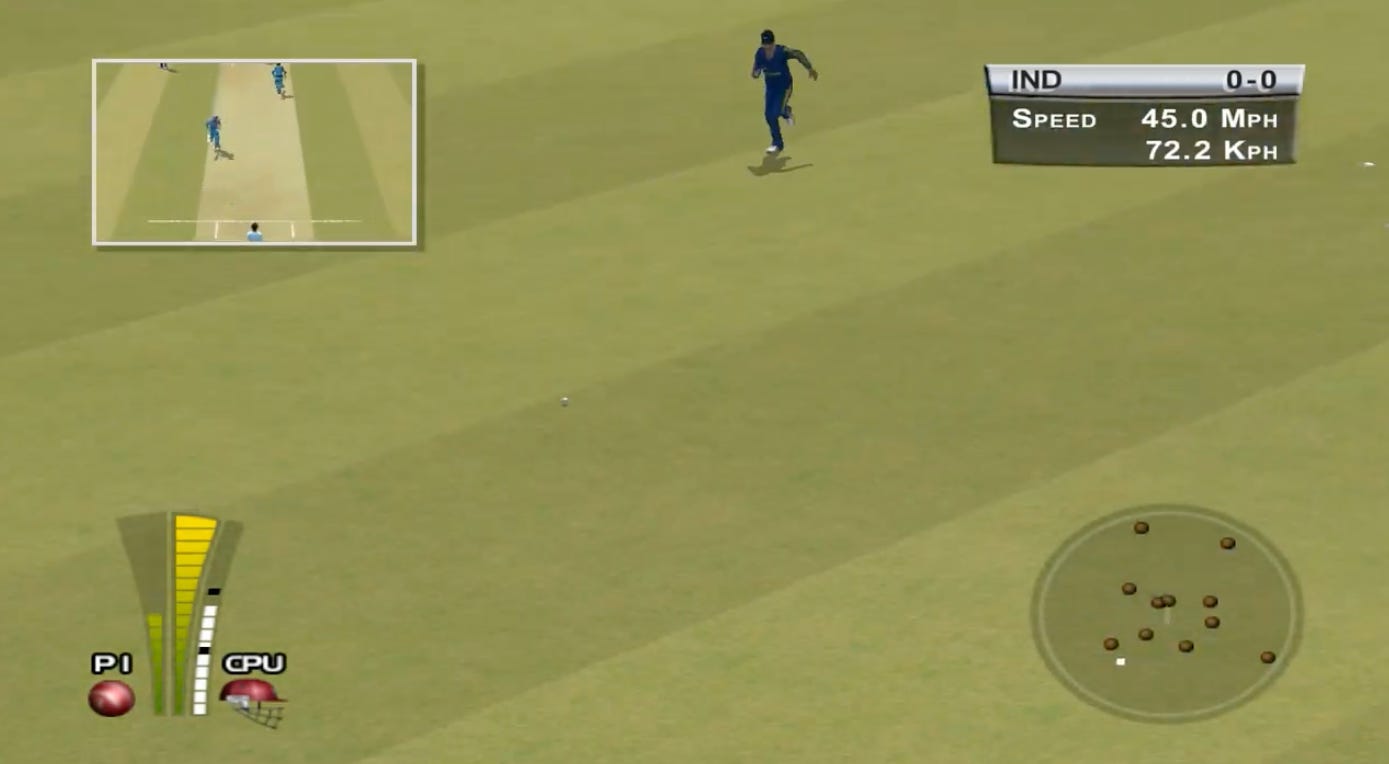
That was the first time I can personally remember seeing that feature, but, of course, this is far from the first time we’ve seen it used in cricket—it used to be the norm for ODIs in Australia in the 80s and 90s, before we decided, after perfecting the technology on the first attempt, to reinvent the wheel and give viewers progressively less context and information. Great job, guys!
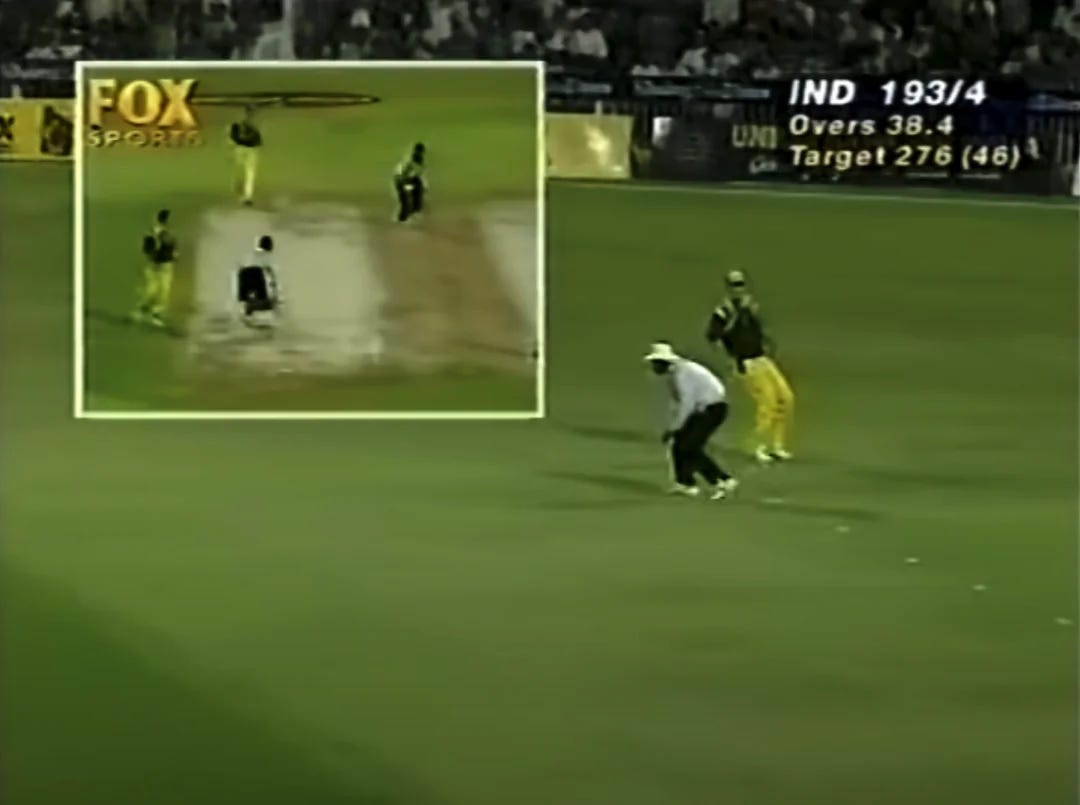
Even the video game feature traces back to Brian Lara Cricket 1994, if not earlier.
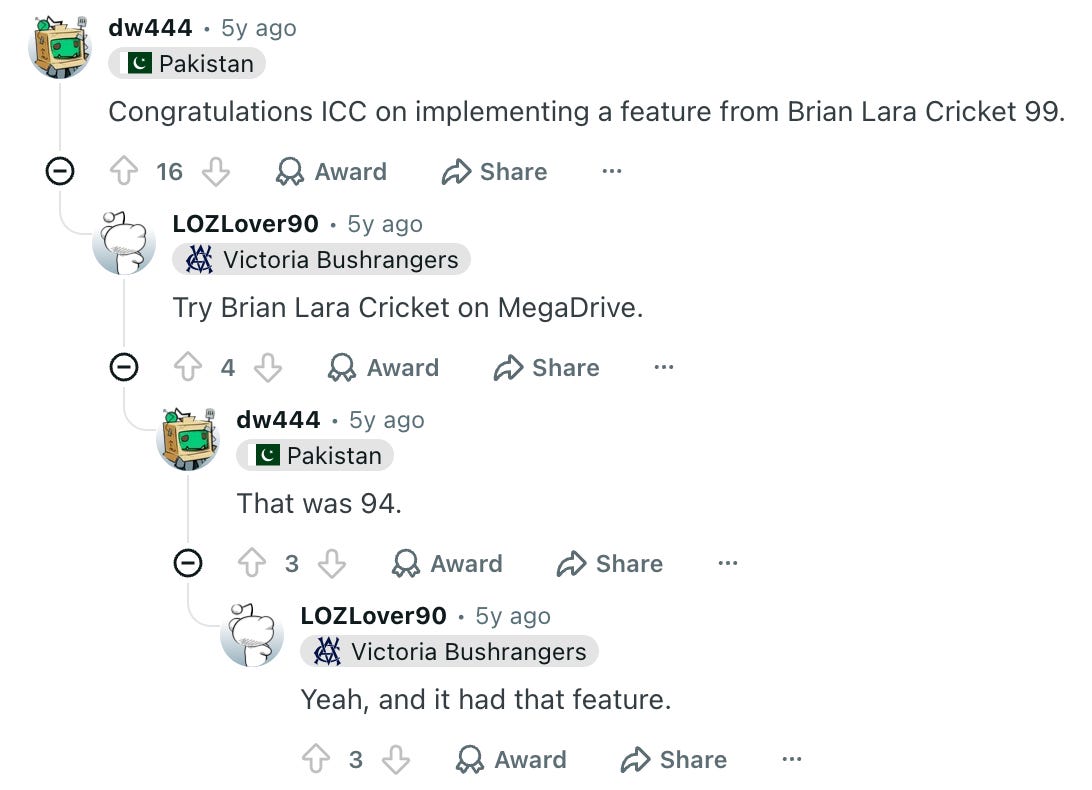
After years in the wilderness, the feature got another spin at the 2011 World Cup, when the ICC boasted: “To give television audiences the most riveting experience, each and every match will be covered by 27 cameras including innovative features like movable slips cameras and new low 45 degree field cameras. The production will also have a mid-wicket camera position for live running between wickets.” Even then, the mid-wicket camera was used more as an occasional replay tool/alternate angle than a consistent picture-in-picture experience.
Then, of course, we got this during the 2021 T20 World Cup:
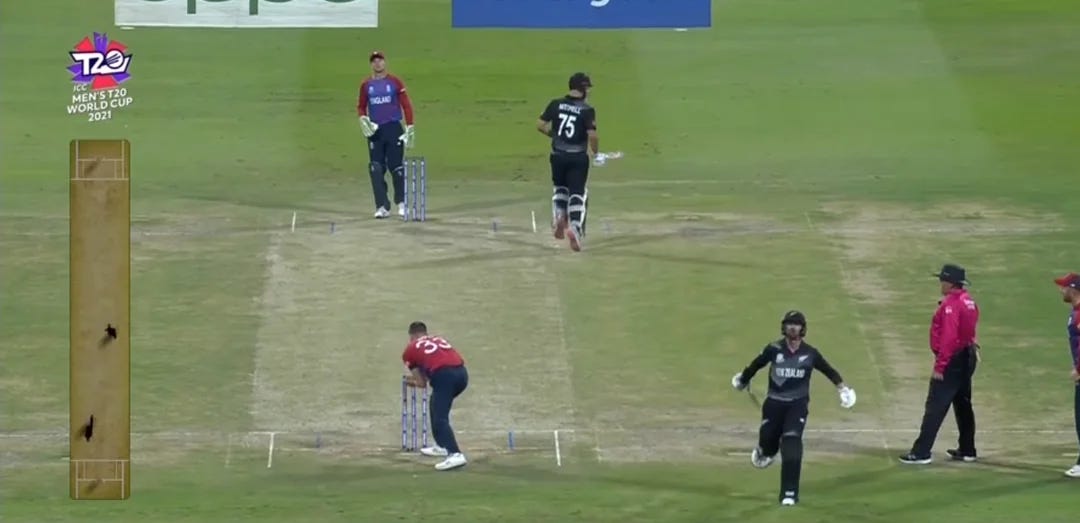
And, ever since, it has more or less disappeared once more. Somehow, over 40 years of cricket coverage, the technology regressed from a live feed of the batters actually running between the wickets, to a supposedly ‘live’ tracker that still shows one batter halfway down the pitch while they’re clearly both safely in their creases.
This really is not a difficult problem to solve. In fact, the issue is not the lack of a solution, but rather, the failure of the ICC and broadcasters to even recognise that there’s a problem, combined with a stubborn insistence on reinventing the wheel.
If the will existed, this issue could be resolved overnight. There are already ~25-50 cameras covering the average cricket broadcast, and all it would take for us to see the part of the game that literally contributes to winning—the physical act of scoring runs—is to keep one (1) of those cameras fixed on the batters while they’re running between the wickets and add a picture-in-picture pop-up of said runs on the screen. This doesn’t require fancy GPS technologies or flashy, new-fangled TV graphics: just one camera and a basic picture-in-picture pop-up; both technologies that we perfected decades ago before inexplicably abandoning.
While We’re At It, How About Fielding Graphics, Too?
That brings me to my second, related complaint about the way cricket is broadcast—which was also solved by a video game in the 90s, if not earlier: the lack of live, on-screen fielding maps.
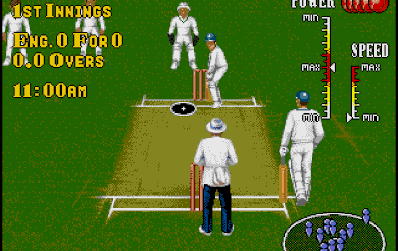
If it is frustrating that we don’t see the batters running between the wickets, it is utterly mind-boggling that we still don’t consistently have a basic, live map of where all 11 fielders are standing. Again, viewers are left to fill in the blanks and piece together their own mental fielding maps, with the occasional help of the commentators. Much like with picture-in-picture running between the wickets, we’ve flirted with this technology on multiple occasions and in multiple different iterations over the years, but have never adopted a consistent, live fielding map that shows viewers where the hell all the fielders are actually standing. That feels kind of important given it directly influences both where the bowler is planning to deliver the ball and where the batter ideally wants to hit it, but what do I know?
You could glean a few extra tactical insights from seeing the batters running between the wickets, but you could open up an entire new world of tactical cricketing insights simply by showing live fielding maps. At its core, this would help to answer the deceptively complex questions: why is this bowler bowling there? And why is the captain doing that? Often, unless it is explicitly obvious with 5 slips and a gully in place or a leg-side dominant field for a bouncer strategy, it is unclear exactly how a bowler/captain is planning to dismiss a batter unless you can see the field.
Unless you’re paying exceptionally close attention, it can be very easy to miss a captain shifting a fielder from second slip to third, or encouraging someone to creep in a few more steps at short mid-wicket, or adjusting fine leg to be slightly squarer. God help you if you’re trying to follow a captain like Ben Stokes, who likes to make a fielding change—sometimes multiple—almost every ball. Having a live fielding map on screen would instantly solve all of these problems. Surely that’s more valuable information to show viewers than a win predictor that no one really trusts, or those ridiculous baseball-card-esque graphics we got at the T20 World Cup earlier in the year? Hell, it might be more valuable than showing how many runs/wickets are required to win: I can do basic maths myself, but I can’t account for a fielding change that was never shown on screen.
Cricket broadcasts focus so much on what is literally happening that we often strip away the context of why it’s happening. That pull shot behind square was ferocious—but we miss the context that the captain moved square leg squarer three balls earlier, so the batter adjusted by hitting it finer. As with picture-in-picture running between the wickets, showing a live field map on screen could unlock a whole new universe of tactical insights and discourse, such as:
What plan is a bowler trying to execute with this field?
Which captains like to move the field the most/least often?
What is a certain bowler/captain’s ‘default’ field?
How much does the field change when different batters are on strike?
How significantly does a field vary between a left-arm and right-arm bowler?
How significantly does a field vary between a left-hand and right-hand batter?
Do certain captains favour/avoid certain fielding positions over others?
Is the captain/bowler prioritising bowling economically, or are they actively searching for wickets?
Which bowlers are the best/worst at bowling to their fields?
Can you see certain fielders drifting out of position and needing reminders of where they’re supposed to be standing?
Which captains follow the ball the most/least?
Which captains change the field to put pressure on a batter when they’re nearing a milestone?
Do some captains set attacking fields but bowl defensively?
Do some captains set defensive fields but create wicket-taking opportunities?
Which batters force captains to abandon their preferred fields?
Which batters attract the most defensive fields?
Which batters are the most effective at manipulating fields?
Which bowlers force captains to set unusual fields?
Which bowlers can create wickets without needing attacking fields?
Which bowlers like to double bluff batters with their fields?
How does the field evolve over different phases of an innings?
And that’s just off the top of my head (ok, I’ve spent several days thinking about it). It is almost unthinkable to me that we’re nearly 150 years into international cricket, and we still don’t have publicly available answers to many of these fundamental tactical questions.
I say publicly available because almost every professional team already analyses these factors internally. Running between wickets and field placements are coached, measured, and reviewed to within an inch of their life, specifically because they influence winning. The frustrating thing is that, despite already finding the solutions, spectators are still almost never invited to see these same ‘hidden’ dimensions of the game.
Instead, if you watched a cricket broadcast right now, you could be forgiven for thinking that the only two skills that really matter are bowling and being able to hit the ball. Everything else, when it comes to the way we broadcast the game, is tertiary. You see fielders only in relation to the ball being hit to them, but not in the wider tactical context of why they’re positioned there, or where all the other fielders are positioned. You see running between the wickets pretty much only when a potential run-out is occurring; otherwise the runs just magically appear on the scoreboard.
As anyone who is reading this will no doubt already appreciate, there is so much more to cricket than just bowling the ball and hitting it. Those might be the headlines, but cricket is very much a sport where the devil is in the details. It’s high time we started focusing on those details—all of them. The good news is, we’ve already solved these issues. The hard part? Getting anyone to actually accept that these are issues to begin with. It’s a radical suggestion, I know, but what if we started broadcasting the part of cricket—running between the wickets—that literally decides who wins or loses the game?
Enjoy my writing? Please consider supporting me via a paid subscription or Buy Me A Coffee. For more information on how your support helps me produce this work and what your contributions go towards, see my About Page!
Like my work, but not that much? Fair enough! If you still want to support me, the best thing you can do is share this article far and wide.
Very good article! Another under-appreciated thing that the picture-in-picture showing the batsmen would convey is actually showing to the people new to cricket how runs are scored. We take it for granted that it's obvious, but I could imagine if someone just randomly switched on a cricket broadcast and watched for a bit, they would possibly be none the wiser as to why the score is going up :)